 Top Trending
Eight Sprays a Day From a Pocket Bottle, Three Nutrients Your Breakfast Already Supplies, and a Listing That Doesn't Say How Much of Them. An Old-School Reading of a Focus Spray Sold Through a Family Distributor in Wisconsin.
Brain Spray is a pocket-size mist from the Daily Sprays line: vitamin B1, L-glutamine and inositol, eight sprays a day, thirty servings to a bottle, sold through a family-run distributor in New Berlin, Wisconsin, and shipped by the maker. The listing names the three nutrients and prints no amounts, so I read it the way my father read a newspaper: the small type first, the headline last.

This is a paid advertisement. Sponsored by Bev and Bob Johnson, independent distributors (New Berlin, Wisconsin).

Howard Lindgren is the pen name of this desk. Nobody at the distributor or the maker spoke to me. There are eight reviews under the seller's listing, and I quote none of them, for a reason explained below. Everything about the bottle comes from the seller's listing and its policy pages, read on September 6, 2026, and everything about the three nutrients comes from the published sources listed at the end of this page.
My father read the newspaper from the back.
Box scores first. Then the classifieds. The front page last, because the front page was where they put the things they wanted you to believe.
I read supplement listings the same way. The panel first. The price second. The promise last.
This listing gave me less to read than most, and that's the story.
Here's what the bottle is.
A slim blue tube the size of a marker pen, from a line called Daily Sprays.
Eight sprays into the mouth make one serving. A serving is 0.47 milliliters, about a tenth of a teaspoon.
Thirty servings to a bottle. So thirty days at one serving a day.
Inside, the listing says, three things: vitamin B1, which is thiamine; L-glutamine, an amino acid; and something it calls vitamin B8, which is inositol.
How much of each? The listing doesn't say.
What else is in it? The listing doesn't say that either.
That's the whole product, as far as the listing lets you see it.
A pocket mist with three familiar nutrients at unstated amounts, sold by a family-run distributor in Wisconsin, with the order completed on the maker's own site.
I did what I always do.
I read the listing twice, looking for a panel.
I worked out what half a gram of liquid can and can't hold.
I read the research behind each of the three nutrients, at the amounts it actually used.
And I read the return policy and the "About us" page, which tell you more here than the product page does.
What I found is a bottle you can't judge from its listing, three nutrients your breakfast already covers, and a fair way to test it anyway.
One more thing before the first item, because most of you got here from one of our own advertisements.
Those ads talk about a boxed cereal, three foods, three drinks, and three words or phrases a man is supposed to be able to say or spell.
None of that is in the tube, and I won't pretend it is. It's on this page, in its place: the cereal box, the drinks and the word test at item eight, and the honest version of every headline we run in the guide linked at the foot.
Item one · The bottleA Tube the Size of a Marker, Eight Sprays, Thirty Days
This is what's on the counter.
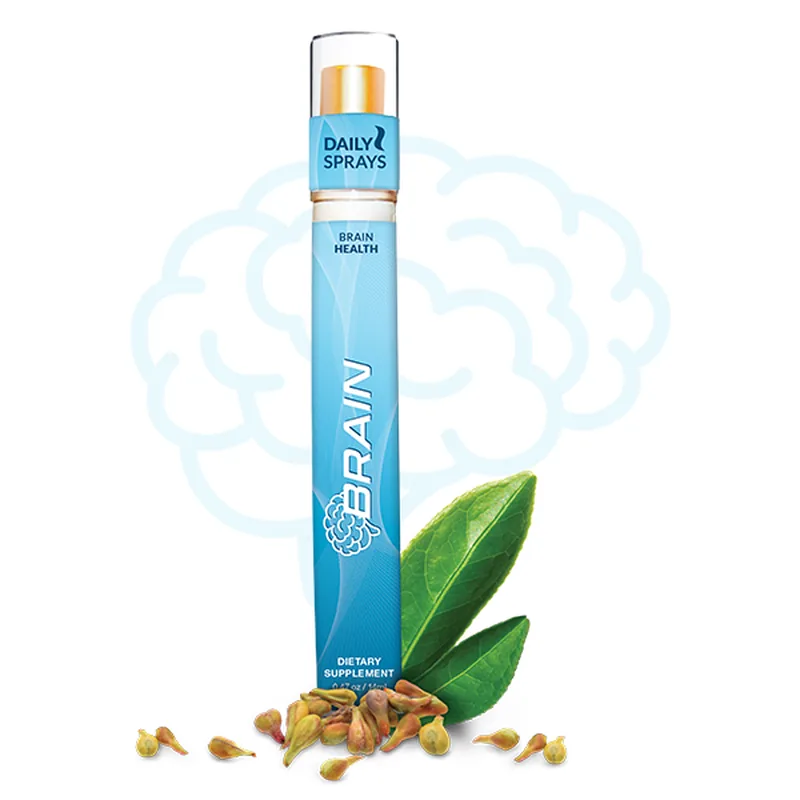
A pale blue tube with a gold cap you could lose in a shirt pocket.
The front says Daily Sprays, then Brain Health, then the word Brain down the side, then Dietary Supplement.
The directions, as far as the listing gives them.
Eight sprays. Thirty servings per container. "Enjoy a spritz anytime, anywhere," and then, in the fine print, follow the directions on the label.
Eight sprays is one serving. Every number on this page is for those eight sprays, or for the lack of them.
Read the listing the way I did, and notice what isn't there.
No Supplement Facts panel.
No milligrams next to any of the three names.
No list of the other ingredients, the water, the sweetener, the flavor, the preservative that every spray of this kind has.
A listing that names three nutrients and prints no amounts is telling you to wait for the bottle. So that's what this page does.
Two more things off the listing before we go on.
The seller is a family-run distributor, by its own account, that has sold the maker's products since 2019 from New Berlin, Wisconsin, with a phone number and an email on every page.
And the order isn't completed there. You click through to the maker's own site, which takes the payment and ships the box.
Hold onto the serving size. Forty-seven hundredths of a milliliter.
It's the only hard number on the listing, and it does more work than you'd think.
Item two · The half gramWhat 0.47 Milliliters Can and Can't Hold
Let me show you the arithmetic, because with no panel, the arithmetic is all there is.

A milliliter of water weighs a gram.
A spray like this is mostly water, so 0.47 milliliters weighs about half a gram.
That half gram is the whole serving: the water, the flavor, whatever keeps it from spoiling, and all three nutrients together.
Whatever the label says when it arrives, the three nutrients in a serving add up to less than half a gram, and the water is most of it.
That's not a scandal. It's what a pocket mist is.
It's a way to put a very small amount of something into your mouth, eight times, with a pleasant taste.
Whether a very small amount is enough is the question, and the three nutrients answer it one by one.
Nothing in this bottle can be more than a few hundred milligrams, and most of it is almost certainly far less.
Item three · ThiamineVitamin B1: The One With a Daily Value, and a Sentence Europe Lets Labels Print
First on the listing, and the only one of the three that's actually a vitamin.

Thiamine is in whole grains, pork, fish, beans and most fortified breads and cereals.
The body can't store much of it, so it has to come from food every few days, and for a man who eats breakfast, it does.
Here's the number to write in your notebook before the bottle arrives.
The U.S. Daily Value for thiamine, the figure every Supplement Facts panel measures itself against, is 1.2 milligrams. [1]
When the label comes, find the thiamine line and read the percentage next to it. That's the whole story of this vitamin in this bottle.
And here's why a small amount is enough for a label to say something nice.
In Europe, a food that supplies as little as 15 percent of the reference value for thiamine, which works out to 0.165 milligrams, may print that thiamine contributes to normal psychological function and to the normal functioning of the nervous system. [2] [3]
Those are lawful sentences about what the vitamin does in everyone. They aren't findings about a spray.
What about extra thiamine, for a man who already gets enough?
A 2018 Cochrane review of 14 trials in nearly 28,000 adults without a deficiency found that B-vitamin supplements probably have little or no effect on thinking, at any point up to five years. [4]
One vitamin, with a Daily Value of 1.2 milligrams, that breakfast supplies, and that trials say does nothing extra for a man who isn't short of it.
So the honest reading of thiamine is: real, necessary, and almost certainly already in you.
If the label's percentage is small, that's the vitamin at the amount a spray can hold. If it's large, you're getting more of something you already have.
Item four · GlutamineL-Glutamine: The Body's Most Plentiful Amino Acid, Used by the Tens of Grams in Hospitals
Second on the listing, and the one whose name sounds the most like a promise.
Glutamine is the most plentiful free amino acid in the body.
Almost every cell you own can make it, which is why nutrition textbooks have long called it nonessential.
It feeds the cells that line your gut and the cells of your immune system, and it carries nitrogen from one organ to another.
It comes with any protein you eat: meat, fish, eggs, dairy, beans. [5]
Where it has been studied as a supplement is in hospitals, in people who are seriously ill or injured, when the body's demand outruns what it can make.
Those studies gave about 0.57 grams per kilogram of body weight a day, roughly 30 grams for a man of 150 pounds, to people in hospital beds. [5]
Thirty grams a day, in hospital patients. The whole serving of this spray weighs half a gram, and most of that is water.
No study has tested glutamine for memory or attention in healthy adults.
Not one. There's nothing to cite, and I won't pretend there is.
Glutamine in a pocket mist is a familiar name at an amount that can't be more than a fraction of a gram, in a man whose body makes it by the gram every day.
Item five · Inositol"Vitamin B8": The Nutrient That Was Struck Off the Vitamin List, Because Your Kidneys Make Four Grams a Day
Third on the listing, and the one with the most interesting name.
The listing calls inositol vitamin B8. It isn't a vitamin, and hasn't been for decades.
It was counted among the B vitamins once, until it turned out that the human liver and kidney make it from ordinary sugar, up to four or five grams a day, most of it in the kidney.
A nutrient the body makes by the gram isn't essential, so it was struck off the list. [6]
It's also in food, in fresh fruit and vegetables and in beans, whole grains and nuts.
So between your kidneys and your breakfast, you're already carrying grams of it. [6]
Four grams a day from your own kidneys. Less than half a gram, all told, in eight sprays.
No study has tested inositol for memory or attention in healthy adults either.
There are trials of inositol, at gram amounts, in people with conditions a doctor has named, and none of that belongs on a page about a pocket spray for a man who's fine.
Calling it vitamin B8 makes it sound like something you might be missing. You aren't. You make it.
Here's where the three names leave us.
A vitamin your breakfast supplies, with a Daily Value of 1.2 milligrams. An amino acid your body makes by the gram and hospitals give by the tens of grams. A sugar-like compound your kidneys make four grams of a day. All three, together, in half a gram of mostly water, at amounts the listing doesn't print.
The bottle is real. The three names are real. The arithmetic says none of them is in there at an amount that could matter, and the listing doesn't argue.
Item six · The reviewsEight Reviews Under the Listing, and Why I Quote None of Them
I always read the reviews, and I always tell you which ones I kept.
This time I kept none, and the reason is worth a minute.
There are eight reviews under this listing, all dated the same day in January, averaging 4.63 stars.
Every one of them describes a bedtime product.
They talk about falling asleep, about a bottle from a different brand, about a formula with a different name.
Not one mentions focus, or a spray, or anything you'd say about this tube.
I don't know how they got there. A cut-and-paste, most likely, when the site was built.
What I know is that the 4.63 you see on the listing belongs to a product that isn't this one.
The star rating on the listing is for something else. Read it as no rating at all.
So this page has no customer voices, and I'd rather tell you that than borrow some.
If you buy it, you'll be the first person I know of to review the thing that's actually in the tube.
Item seven · The likelier explanationWhy Eight Sprays at Three O'Clock Feel Like Something, and What Else Does the Same Job for Free
Suppose you buy it, spray it at three, and feel a little sharper by ten past.
I'd believe you. And I'd give you three reasons before I gave the nutrients one.

You stopped. You put the coffee down, found the tube, counted to eight. Thirty seconds away from the page you were rereading.
You tasted something. A sharp taste in a dry mouth at three o'clock wakes a man up for a minute, the way a mint does.
You skipped the third cup. So at eleven that night you're asleep instead of doing arithmetic on the ceiling.
None of that is in the tube. All of it comes with the tube.

What actually helps, and costs nothing, is dull.
- No coffee after two. Water, or the spray, in its place.
- One thing at a time. Radio off while you read the manual.
- Ten minutes outside before the hard part of the afternoon.
- The newspaper on paper, not on the phone. You'll finish the article.
- Seven hours in bed, or as close as a man your age can get.
Now look at that list and be honest.
You've heard every item since your first physical, and you still don't do them.
Boring loses to coffee every time.
If a blue tube gets you to skip the three o'clock cup, it did its work before the thiamine did anything. And the thiamine isn't going to do anything.
Item eight · The bowl and the cupThe Cereal Box Prints Its Numbers and This Listing Doesn't: The Cereal, Three Drinks, Three Foods and the Word Test From Our Own Advertisements
Our advertisements have been saying, in one version or another, that a boxed cereal, three foods and three drinks have something to do with memory, and that there are three words or phrases a man ought to be able to say.
You're owed the honest version, in small type, so here it is.

Start with the box, because it does what this listing doesn't: it prints its numbers.
Turn a frosted, honey-coated or chocolate cereal on its side and the sugar line is right there, to the gram, and a serving can carry more of it than a biscuit.
No cereal "ages the brain faster than time." Nobody has measured any such thing, and that phrase was written to be clicked.
What the studies do say is duller, and worth more.
In the Framingham Heart Study, adults who drank more sugary beverages scored lower on tests of memory, and daily fruit juice went the same way. [7]
In a Brazilian study of 10,775 adults followed for eight years, the ones who ate the most ultra-processed food, and the sweet cereal shelf is part of that, lost ground on tests of thinking about a quarter faster than the ones who ate the least. [8]
Both are associations across a population, not a sentence on your bowl. And a quarter faster than slow is still slow.
The three drinks.
The "evening drink" in our advertisement is alcohol, and it's the one with the strongest case behind it: in 550 British civil servants followed for thirty years, the more a person drank, the faster their scores fell on a word-fluency test, and light drinkers had no edge over those who didn't drink at all. [9]
The second is sugar in a glass: soda, sweetened tea, the tall flavored coffee from the counter, which is a soft drink with coffee in it. The Framingham finding above is about sugary drinks, and those are sugary drinks. [7]
The third, in one of our headlines, was coffee. That was our worst headline.
Plain black coffee isn't the drink any of those studies were about. Keep your coffee. Keep it before two, which is the whole point of this tube anyway.
The three foods.
Processed meat, fried food, and the white-flour shelf: pastries, packaged cakes, white bread.
Our advertisement says "just stop eating these three." The research says something slower.
In 960 older adults followed for nearly five years, the ones whose meals looked most like the MIND pattern, vegetables, berries, nuts, whole grains, beans, fish and olive oil, held their thinking scores better, and the gap between the top and bottom thirds worked out to about seven and a half years of age. [10]
That's a pattern over years, not a list of three, and it can't be sold in a headline. Which is exactly why our headline doesn't say it.
Less sugar in the bowl and the glass. Less alcohol in the evening. Keep the coffee, before two. Eat more like the Mediterranean shelf and less like the vending machine. Every one of those is free, and none of them is in the tube.
The three words, or the three phrases.
There's no such list. What our advertisement borrowed from is the short, scored mental-status test clinicians have given at the bedside since the 1970s: the date and the place, a few words to hold in mind and give back a minute later, a sum, naming, repeating one sentence, copying a drawing.
It's given in person and read against your age and your schooling by someone trained to do it, and a low score is a reason for a proper look, not a verdict.
Stumbling on a word when you're tired or being timed means nothing on its own. Nothing begins at a word.
If the worry behind the click is real, that's fifteen minutes with your doctor, and it costs you nothing from me.
And the advertisement about the things some men take every day.
That one sits closest to real research, and it's the one an advertisement has no business acting on.
Some kinds of daily medicine, including a few sold over the counter for allergies and for sleeping, are on the lists pharmacists check for people over 65.
Don't stop or change any of it because of an advertisement, ours included. Put everything you take in one bag, take it to the pharmacist, and ask one question: is anything here a poor choice at my age? The guide at the foot of this page has that section written out, with the studies.
So if you clicked on the cereal, here's where the cereal went: onto its side, where the numbers are. Which is more than this tube's listing will do for you.
Item nine · What it isn'tSix Things Eight Sprays Won't Do
- It won't tell you how much of anything you're getting until the bottle is in your hand. The listing prints no amounts.
- It won't give you a nutrient you're short of, if you eat breakfast. Thiamine comes with the toast; glutamine and inositol your body makes by the gram.
- It won't act on any condition a doctor has named. It's a dietary supplement, and the listing carries the sentence that says so.
- It won't come with reviews of itself. The eight under the listing describe a different product.
- It won't be sold to you by the people whose name is on the page. The distributor lists it; the maker takes the payment and ships it.
- It won't come back for a refund if you've opened it, as far as the distributor's policy says. Thirty days, unopened, and the shipping isn't refunded.
If that list annoys you, I'd rather you were annoyed now than when the box arrives.
Item ten · The routineIf You Do Buy It: One Bottle, a Phone Call, the Panel in a Notebook, and Thirty Days
If you're going to spend the money, spend it as a test with a date on it, and test the thing that can actually work.

- Buy one bottle. Thirty servings is the test, and there are no reviews to tell you more.
- Call the number on the seller's page before you open it, and ask one question: can I return it opened? Write down the answer and the name of the person who gave it.
- When the box arrives, read the panel before the first spray. Write the three amounts in a notebook, and next to the thiamine, write 1.2 milligrams, the Daily Value, so you can see the fraction.
- Eight sprays, once, at the hour you'd have poured the third coffee. That's the only time it matters.
- Nothing after two but water and the spray. Make the afternoon match the tube.
- On day thirty, ask one question: did I skip the afternoon coffee more days than not? If yes, the tube earned its keep. If no, nothing in it will save it.
Look at that list the way I do.
Four of the six things are free.
The tube is the one you'll pay for, and the skipped coffee is the one that will do the work.
Item eleven · Who it's forWho It Suits, and Who It Doesn't
This is worth a look if:
- You reach for a third or fourth coffee every afternoon and you know it costs you the night.
- You want a pocket ritual with three familiar nutrients and no caffeine on the listing.
- You can hold two ideas at once: real nutrients, at amounts a half-gram serving can't make large.
- You'll read the panel when it arrives and write the numbers down, instead of trusting a listing that didn't print them.
- You'll run it as a thirty-day test, counting skipped coffees, not as a hope.
Give it a miss if:
- You want to know the amounts before you pay. The listing doesn't give them, and I couldn't get them either.
- You want something that acts on a condition a doctor has named. This is a food.
- You want customer reviews of this product before you buy. There aren't any; the ones under the listing are for something else.
- You want to try it and send it back if you don't like it. The distributor's policy covers unopened products. Call first.
- Your liver or your kidneys give you trouble. Glutamine's reference texts advise care with high doses; at this amount it's a footnote, but ask.
- You're pregnant or nursing. The listing itself says to ask a doctor first.
Item twelve · Where it's soldListed in Wisconsin, Shipped by the Maker, With a Return Policy Worth Reading Twice
The tube is listed by a distributor on its own website, and that's the only place this page links to.

The distributor is easy to find.
A family-run site, by its own account, run by Bev and Bob Johnson from New Berlin, Wisconsin, since 2019, with a phone number and an email on every page and a "Contact us" that answers by phone.
It says, in plain words, that it's an independent distributor and not the maker's own site, and that it may earn a commission on what it links to.
I couldn't check any of that beyond the pages themselves, and I'm not repeating it as mine.
The current price is shown on its page, not here.
The day I read it, a tube cost a little over twenty dollars, before whatever the maker's checkout adds for shipping.
Now the two things that matter more than the price.
First, who actually sells it.
You click "Buy" on the distributor's page and land on the maker's own site, which takes your payment and ships the box.
The distributor's own words: the maker's current pricing, shipping policies and satisfaction guarantee apply.
I couldn't read those pages from here, so I can't tell you the shipping charge or the maker's own refund terms. Read them at checkout before you pay.
Second, the return policy, which is the distributor's and which I could read.
Contact them within 30 days of the purchase date and ask for a return authorization.
If approved, you get a full refund of the purchase price, less shipping and handling.
The products, it says, should remain unopened and unused unless otherwise specified.
There's a "30-day money-back guarantee" badge on the same page.
A badge that says money-back and a policy that says unopened are two different promises. The phone call in the routine above is how you find out which one you're buying.

Everything the listing names
| Ingredient | Amount per serving |
|---|---|
| Vitamin B1 (thiamine) | not printed on the seller's listing |
| L-glutamine | not printed on the seller's listing |
| Inositol (called "vitamin B8" on the listing) | not printed on the seller's listing |
| Other ingredients: not listed on the seller's listing | — |
Full details on each ingredient are in the guide linked at the bottom of this page.
The ingredient and advertising guide linked at the foot of this page goes through each of the three nutrients.
What it is. What the research does and doesn't show, at what amounts. What to be careful about. And which of our own headlines it does and doesn't support.
Print it and take it, with the bottle, to the pharmacist if you take anything daily. It's written for that.
See the current price on the seller's site
A pocket spray with vitamin B1, L-glutamine and inositol, eight sprays a day, sold through an independent distributor in Wisconsin and shipped by the maker.
CHECK AVAILABILITYListed by Bev and Bob Johnson, independent distributors in New Berlin, Wisconsin; the order is completed and shipped by the maker, whose shipping and guarantee terms apply at checkout · Distributors' return policy: contact within 30 days for authorization, refund less shipping, products unopened unless otherwise specified
QuestionsWhat Readers Ask Me Before Their First Bottle
Questions readers ask
Is this medicine?
No. It's a dietary supplement, a pocket mist with vitamin B1, L-glutamine and inositol, and the listing carries the standard sentence that its claims haven't been evaluated by the FDA.
How much thiamine, glutamine and inositol is in a serving?
The listing doesn't say, and I couldn't get the label. The whole serving is 0.47 milliliters, about half a gram of mostly water, so all three together are less than that. Read the Supplement Facts panel when the bottle arrives and write the numbers down.
What's the thiamine number to compare against?
The U.S. Daily Value is 1.2 milligrams. Whatever the panel says, divide by that and you have the fraction of a day's thiamine in eight sprays.
Is vitamin B8 something I'm missing?
No. "Vitamin B8" is inositol, which was struck off the vitamin list because your liver and kidneys make about four grams of it a day. It's also in fruit, beans, grains and nuts.
Does it have caffeine or sugar?
The listing names no caffeine. It doesn't print a full ingredient list, so I can't tell you about sugar or sweeteners; the label will.
What does it taste like?
The listing doesn't say, and there are no reviews of this product to tell you. Sprays of this kind are usually sweetened and flavored.
Why don't you quote the reviews on the listing?
Because all eight describe a bedtime product from a different brand. Same date, different bottle. The 4.63-star rating is theirs, not this tube's.
Who am I buying from?
You're listed to by a family-run distributor in Wisconsin, Bev and Bob Johnson, and sold to by the maker on its own site, which ships the box. The maker's shipping and guarantee terms apply at checkout, and I couldn't read them from here.
Can I return it if I don't like it?
The distributor's policy says contact them within 30 days for authorization, refund less shipping, and products unopened unless otherwise specified. The page also shows a money-back badge. Call the number and ask before you open it.
Will it help my memory or focus?
I can't tell you that, and you should be wary of any page that does. None of the three nutrients has a trial for memory or attention in healthy adults, and all three are already in a man who eats breakfast. What it reliably does is replace the afternoon coffee for thirty seconds and a taste, and that's worth exactly what you make of it.
Can I take it alongside what I already take?
Ask your doctor or pharmacist, and take the bottle, not the listing, because the listing doesn't print the panel. Glutamine's reference texts advise care with high doses when the liver or the kidneys are under strain, and the listing itself says to ask before use in pregnancy or alongside anything a doctor has given you.
Your advertisement was about a cereal, or three foods, or three drinks. Where is that on this page?
In item eight, in full, with the studies. The short version: less sugar in the bowl and the glass, less alcohol in the evening, keep your plain coffee before two, and eat more like the Mediterranean shelf. None of it is in the tube, and the ingredient and advertising guide at the foot goes through every headline we run and says which ones overstate.
Your advertisement said something about three phrases, or spelling three words. Is there a test I can take?
Not on a screen. The words and phrases come from the short mental-status test clinicians give in person, and it's read against your age and schooling by someone trained to do it. Nothing begins at a word. If the worry behind the click is real, ask your doctor for the proper test. It's fifteen minutes.
The short versionEverything Above, in Sixty Seconds
- A slim blue pocket spray from the Daily Sprays line, listed by a family-run distributor in New Berlin, Wisconsin, with a phone number and an email, and sold and shipped by the maker.
- Eight sprays make a serving of 0.47 milliliters, about half a gram. Thirty servings to a bottle.
- Three nutrients named, no amounts printed: vitamin B1, L-glutamine and inositol, which the listing calls vitamin B8.
- Thiamine's Daily Value is 1.2 milligrams, [1] breakfast supplies it, and trials find no extra benefit in people who aren't short of it. [4]
- Glutamine is the body's most plentiful amino acid; hospitals give it by the tens of grams. [5] Inositol isn't a vitamin; your kidneys make about four grams a day. [6]
- Eight reviews under the listing, all for a different product. No customer voices on this page.
- Return policy: 30 days, authorization first, refund less shipping, unopened unless otherwise specified. Call before you open it.
- The cereal, three drinks, three foods and the word test from our own advertisements, in item eight: less sugar, less alcohol, keep the coffee before two, more like the Mediterranean shelf, and no test on a screen. None of it is in the tube.
- The honest use: a caffeine-free ritual in place of the three o'clock coffee. Buy one, write the panel in a notebook, count the skipped cups for thirty days, and let the count decide.
The last itemWhat Eight Sprays Are Actually Worth
Here's the whole thing in one breath.
Three names you've heard, in half a gram of mostly water, at amounts the listing wouldn't print.
A vitamin from your toast, an amino acid your body makes, and a sugar your kidneys turn out by the gram.
In a blue tube that fits in a shirt pocket and takes thirty seconds at three o'clock.
If you're a man who pours a coffee at three and pays for it at eleven, that last line is worth more than the first two.
Not because of what's in the spray. Because of what you didn't pour.
Buy one, not three, call before you open it, write the panel in a notebook, and count the days you skipped the cup. The count is a better judge than I am.
Check the current price and availability
A pocket spray with vitamin B1, L-glutamine and inositol, eight sprays a day, sold through an independent distributor in Wisconsin and shipped by the maker.
CHECK AVAILABILITYListed by Bev and Bob Johnson, independent distributors in New Berlin, Wisconsin; the order is completed and shipped by the maker, whose shipping and guarantee terms apply at checkout · Distributors' return policy: contact within 30 days for authorization, refund less shipping, products unopened unless otherwise specified
P.S. If you take one thing from this page, take the half gram. Eight sprays weigh about half a gram, water included, and the listing prints no amounts. Everything else about this tube follows from holding that number next to the three names.
P.P.S. If the afternoon fog has been with you for a year, and it's there in the morning too, talk to your doctor before you buy anything. A pocket spray is a small habit. It was never going to answer a question a doctor answers in fifteen minutes.
P.P.P.S. And if you do order it, read the panel before the first spray and write it down. You'll be the only person I know of who has, and you'll know more about this tube than its listing does.